
Lion Mountain, Le Morne Brabant or Le Pouce?
Three mountains come up again and again when visitors ask where to hike in Mauritius. Le Morne Brabant is the famous one, a World Heritage landscape in the south-west. Le Pouce is the popular one, the thumb above Port Louis. Lion Mountain is the quiet one, a short, steep ridge above the oldest bay on the island. This page compares them on the things that decide a day, using the figures our sources actually give.
Read the guide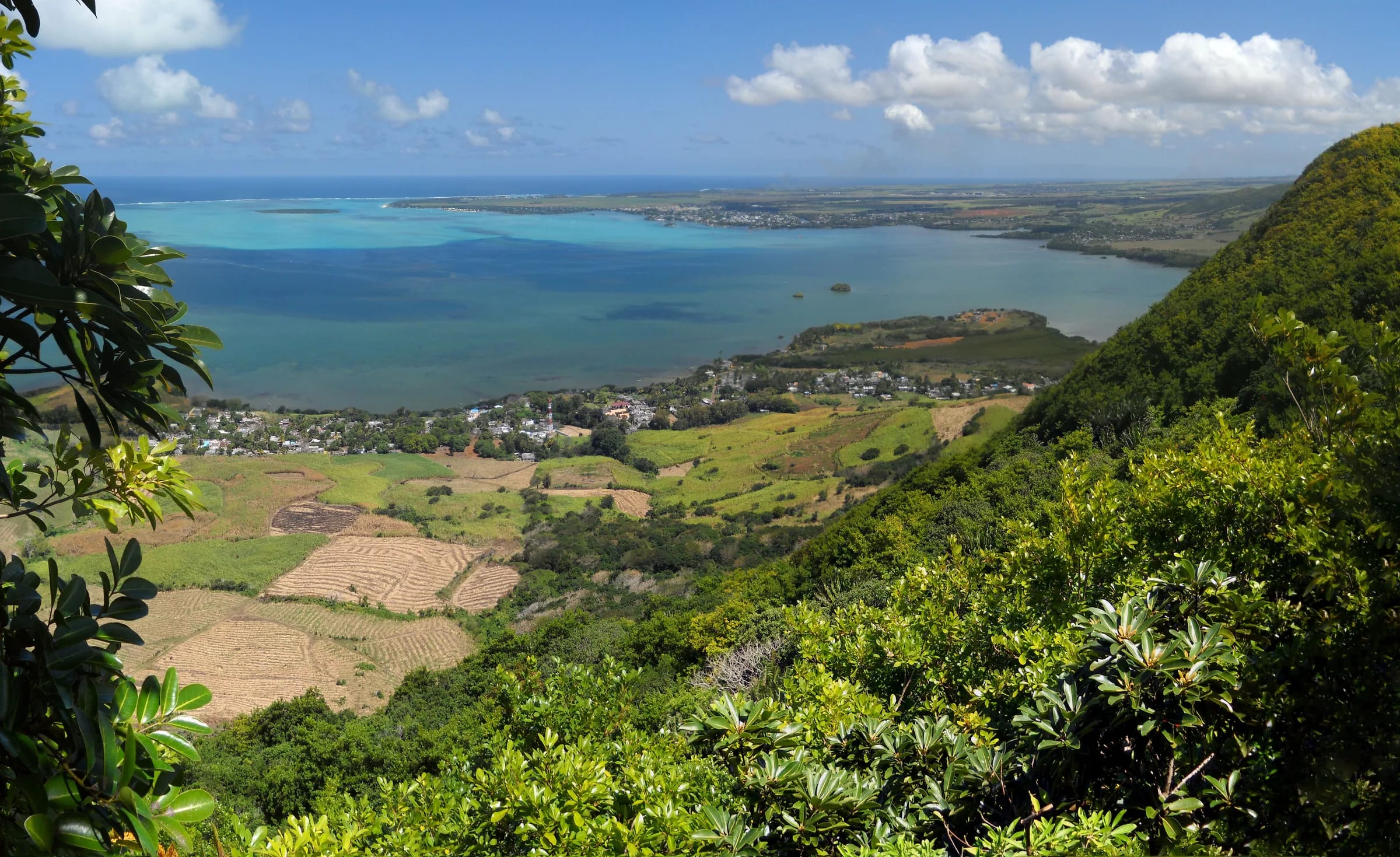
Three mountains, three different days
The numbers below come from the mapped routes on this site and its sister guides, from the Le Morne Heritage Trust Fund’s published grades and from the sources listed at the end. Where sources disagree, the range is given. One caution before the table. Le Morne’s upper section, the Grade 3 scramble to the metal cross, was closed until further notice because of rockfall danger when this page was written, and the summit was prohibited even with a guide. Check the trail status before you plan a day around it.
Pieter Both is included briefly because people ask. It is a different kind of objective, a roped climb to a balanced boulder that requires a professional guide, a helmet and a harness, and it appears here only to show where the other three stop.
Height, distance and ascent
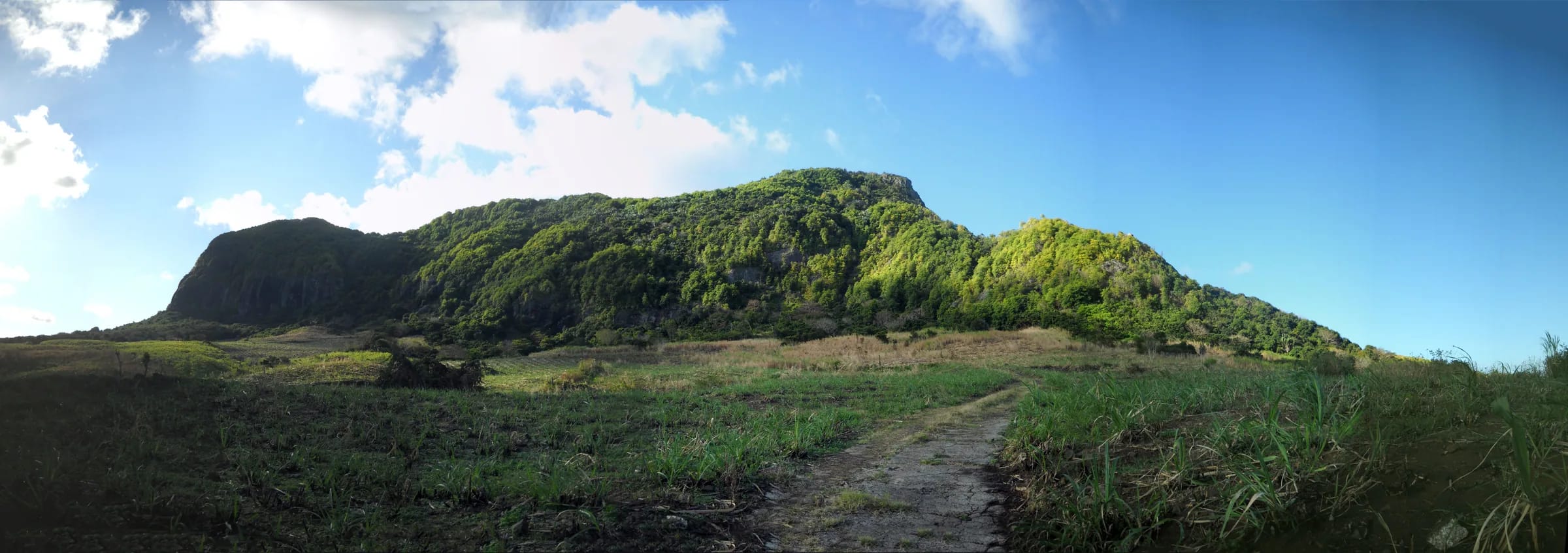
Height tells you little on its own. Lion Mountain is the lowest of the three at about 480 m, with sources ranging from 440 to 490 m, but the mapped spine starts at about 37 m in Vieux Grand Port and climbs roughly 400 m in 1.8 km. Le Pouce is 812 m, the third-highest point on the island, yet the standard route from the Petit Verger car park starts at 381 m and climbs about 390 m over 2.05 km, almost exactly the Lion Mountain figure spread over a longer path. The Port Louis route from Tranquebar is the serious one, 3.6 km one way with about 690 m of ascent.
Le Morne Brabant is 556 m, but the visitor trail does not go to the top. Section 1 runs 2.53 km from the entrance near sea level to Viewpoint 2 at about 260 m, graded 1 by the Trust Fund. Section 2 adds 760 m of path and a Grade 3 scramble to the metal cross, so the full visitor route is 3.29 km one way with roughly 490 m of ascent. Pieter Both’s route from La Laura is 3.3 km return with about 450 m of ascent, the last part on rope.
| Measure | Lion Mountain | Le Morne Brabant | Le Pouce |
|---|---|---|---|
| Height | About 480 m (440 to 490 m in sources) | 556 m | 812 m |
| Start | Vieux Grand Port, about 37 m | Trail entrance, near sea level | Petit Verger, 381 m |
| Distance one way | 1.8 km | 2.53 km to Viewpoint 2, 3.29 km to the cross | 2.05 km |
| Ascent | About 400 m | About 260 m to Viewpoint 2, about 490 m to the cross | About 390 m |
| Time | 3 to 4 hours return | 2 to 3 hours on the lower trail, 3.5 to 4.5 hours to the cross | 2 to 3 hours return |
| Exposure | Hands on rock from low on the ridge, exposed head | Grade 1 path, then a Grade 3 gulley with loose rock | Narrow and steep for the last few metres |
| Navigation | Unmarked through cane, informal marks above | Managed trail with an entrance | Blue and white waymarks, excellent visibility |
| Guide | Optional | Optional on Section 1, summit closed | Optional |
| Fees and hours | Free, no hours | Free, gate 07:00 to 16:00, latest start 14:30 | Free, no hours |
| View | Grand Port bay, Île aux Aigrettes, Mahébourg, the airport | The south-western lagoon and peninsula | Port Louis, the harbour, Pieter Both, the north coast |
Time and effort
Most hikers need 3 to 4 hours for Lion Mountain return, including time on the head, and fit walkers do it in about two and a half. The distance is tiny; the time goes on the rock steps, where you use your hands for a good part of the climb and the descent. Le Pouce from Petit Verger takes 2 to 3 hours for most people, with sources ranging from 1 hour 45 minutes to 4 hours, and the first hour is a steady walk on a good path to the plateau below the summit. Le Morne’s lower trail is a 2 to 3 hour return as a planning estimate, while the full route to the cross, when open, is given as 3.5 to 4.5 hours.
In effort terms Le Pouce is the gentlest, because its ascent is spread over a longer, better-made path. Lion Mountain and the full Le Morne route are similar in total climb, but Lion packs it into half the distance, so the gradient and the amount of hands-on rock are greater. Pieter Both takes about four hours for 3.3 km, which tells you how much of that time is spent on ropes.
Exposure and scrambling
This is where the three part company. On Lion Mountain the scrambling starts low, in a steep root-filled gully to the ridge, continues as rock steps along the lion’s back and ends on the head, which is genuinely exposed with drops on more than one side. One recorded account estimates that you use all four limbs for roughly half of the ascent and descent, and Komoot users rate the route T3 to T3+. Anyone uneasy with drops can stop just before the head and still have a fine view.
Le Pouce is a walk until the last few metres. The col is reached in under an hour, the plateau below the summit is open grass, and the final thumb is narrow and steep, with a hand or two needed over a few metres and a short trench along the ridge. People who dislike heights stop at the plateau and lose little. Le Morne’s Section 1 is a Grade 1 path with uneven ground and care needed near edges. Section 2 is another matter, a gulley of steep rock with hands-on scrambling, loose rock, rockfall risk and real wind exposure, and rockfall is the reason for its closure.
Views
Lion Mountain gives you a bay. From the head and the flag viewpoint you look down on the whole of Grand Port, the lagoon, Île aux Aigrettes, Mahébourg and the airport runway, with the Bambous range and the cane inland. It is an intimate, legible view of one corner of the island, and early in the morning you may well have it to yourself. Le Pouce gives you a capital. The summit looks straight down on Port Louis and its harbour, across to Pieter Both’s boulder and north to the coast and Coin de Mire on a clear day, with Moka and the towns of the plateau behind.
Le Morne gives you a lagoon. The peninsula is almost surrounded by shallow water, and the viewpoints look over the south-western lagoon and the reef, on the sunset side of the island. On a clear afternoon it is a fine place to be, with the sun going down over the water.
Who should choose which
The honest conclusion is that Lion Mountain is the shortest, the quietest and, for its height, the most exposed of the three. Le Pouce confines its exposure to the last few metres and Le Morne’s exposed section is closed, while Lion Mountain asks for your hands from low on the ridge and finishes on a head with drops around it. It is not the hardest mountain on the island, but it is harder than its 480 m suggests, and it rewards people who know that before they start.
- Choose Le Pouce if you want a first mountain in Mauritius, a well-marked path, a big view over the capital and the option of stopping below the summit with no loss of pride.
- Choose Le Morne’s lower trail if you want the heritage landscape, a managed path with set hours and a gentle Grade 1 walk to a viewpoint over the lagoon. Do not plan on the summit until the Trust Fund reopens Section 2.
- Choose Lion Mountain if you are comfortable with your hands on rock, want a short, steep objective with a real sense of exposure and like the idea of a quiet ridge above a bay full of history, with Mahébourg and Blue Bay for the afternoon.
- Choose Pieter Both only with a guide, ropes and a head for heights.
- Choose none of them in heavy rain or strong wind. All four are slippery when wet and exposed to the trade winds on their upper parts.
Questions people ask
Is Lion Mountain harder than Le Morne?
It depends which Le Morne you mean. Le Morne’s lower trail to Viewpoint 2 is a Grade 1 path and clearly easier than Lion Mountain. The full route to the cross includes a Grade 3 scramble with loose rock and is at least as demanding, but it was closed for rockfall danger when this page was written. Lion Mountain’s exposure is open to anyone, which is its challenge.
Which is the easiest of the three?
Le Pouce from Petit Verger. It starts at 381 m, follows a waymarked path with excellent visibility and reaches an open plateau in about an hour. Only the final few metres are narrow and steep, and you can stop below them. Le Morne’s lower trail is also easy walking, but longer, and bound by gate hours.
Do I need a guide for any of them?
Pieter Both, yes, with ropes, helmet and harness. Lion Mountain and Le Pouce, no, although a guide helps on Lion Mountain because the line through the cane is unmarked. Le Morne’s lower trail may be walked independently when access and conditions allow, and a guide cannot get you into a closed section.
Can I do Lion Mountain and Le Morne in one day?
They stand at opposite corners of the island, Lion Mountain in the south-east by the airport and Le Morne on the south-west peninsula, and both are best in the morning. Le Morne also has a latest start of 14:30. One mountain and a swim is a good day in Mauritius; two mountains is a long one with little reward in either.
Which has the best view?
They are different rather than better. Lion Mountain looks down on the bay of Grand Port, Île aux Aigrettes and the runway from the flag viewpoint and the head. Le Pouce looks down on Port Louis, the harbour and Pieter Both. Le Morne’s viewpoints face the south-western lagoon. For a view you share with few others, Lion Mountain is the one.
Is Le Morne open to the summit?
Not when this page was written. The Trust Fund had closed Section 2, from Viewpoint 2 to the metal cross, until further notice because of rockfall danger, and access to the summit was prohibited even with a guide. Section 1 to Viewpoint 2 remained open within the 07:00 to 16:00 window. Check the current status before travelling.
Judge the ridge for yourself
The difficulty page breaks Lion Mountain into its easy, steep and exposed parts for different kinds of hiker.