
Lion Mountain weather and the best time to climb
Lion Mountain stands on the windward side of Mauritius, where the south-east trade winds arrive first and drop their rain. That makes this coast wetter than the west and the ridge greener, foggier and more slippery than its modest height suggests. The coast at Mahébourg is still drier than the island average, though, and the cooler months from May to November give long runs of good hiking weather. This page explains the pattern, gives the monthly numbers from the nearest weather station and shows what the summit is doing right now.
Read the guide
Why the south-east gets the weather
Mauritius lies in the belt of the south-east trade winds, steady surface winds that blow out of the subtropical high towards the equator. They reach the island on the south and east coasts, and when they meet the mountains and the central plateau they are forced upward, cool and drop their moisture. Climatologists call this orographic rain, and a peer-reviewed study of the island’s rainfall describes exactly that pattern, with the windward south and east receiving the rain, the central plateau the wettest of all and the north and west coasts sitting in a drier rain shadow. The UK Met Office puts it more bluntly, noting that the east coast and the plateau catch most of the wet weather while the west coast is much drier.
Lion Mountain stands directly in the path of those winds on this stretch of coast, which is why cloud can sit on its ridge while the coast below is in sunshine. The Mauritius Meteorological Services add two details worth knowing. The trade winds strengthen when a cold front passes to the south of the island, which happens most in winter, and thunderstorms are a summer affair, mostly from December to April. The winds themselves blow hardest in July and August, which is when the ridge is windiest and Pointe d’Esny and Blue Bay are described as noticeably windy too.
Rainfall and temperature month by month
The nearest long-term weather station is at Plaisance, the airport, 6 to 9 km from the mountain. Its 1991 to 2020 record gives a good picture of the coast at the foot of Lion Mountain, with about 1,659 mm of rain a year spread over 12 to 19 rain days a month. Daytime highs reach 30 °C from December to March and fall to 25 °C in July and August, while nights drop from 24 °C in January and February to 19 °C between June and September.
Two things stand out. First, the coast is drier than people expect. The official East region figure for the same period is 2,640 mm a year, but that average includes upland stations, and the island mean is 2,018 mm, so Mahébourg’s coast gets less rain than the island as a whole and far less than the plateau, though nearly twice as much as the west coast at about 920 mm. Second, the seasons are strongly marked. Roughly two thirds of the island’s rain falls in the summer half of the year, from November to April, and October is the driest month almost everywhere.
| Month | Rainfall | Season |
|---|---|---|
| January | 255 mm | Summer, hot and humid, cyclone season |
| February | 258 mm | Summer, the wettest month |
| March | 237 mm | Summer, still hot and wet |
| April | 197 mm | Summer easing, cyclone season continues |
| May | 142 mm | Between seasons, cooling |
| June | 95 mm | Winter, cool and breezy |
| July | 82 mm | Winter, strongest trade winds |
| August | 72 mm | Winter, strongest trade winds |
| September | 66 mm | Winter ending, dry |
| October | 49 mm | Between seasons, the driest month |
| November | 84 mm | Summer beginning, cyclone season opens |
| December | 122 mm | Summer, heat building |
The May to November window
Local guides put the hiking season for Lion Mountain at May to November and advise dry weather only, and the monthly numbers explain why. From May the rain falls away sharply, the daytime highs ease to the mid twenties, the nights are fresh and the cyclone window closes in mid May. June to September is cool, dry and windy, with the trade winds at their strongest in July and August and the latest sunrises of the year, so a 07:00 start is comfortable rather than urgent. September and October are the driest months and remain pleasant before the heat returns.
November is a hinge month. It is still dry on the coast, with the earliest sunrises of the year, but it is also the official start of the cyclone season and the first thunderstorms can arrive late in the month. December to March is hot, humid and wet, with daytime highs of 30 °C on the coast, afternoon storms and the real possibility of a cyclone warning. The mountain can still be climbed on a clear morning in summer, and one route app records its busiest period as running from July right round to May, but you plan around the forecast rather than the calendar, start at first light and accept that the clay will be slippery.
Cyclone season and the warning classes
The Mauritius cyclone season officially runs from 15 November to 15 May, slightly longer than the south-west Indian Ocean season as a whole, which closes at the end of April. Most activity falls between January and March. The Mauritius Meteorological Services issue warnings in four classes, and the simple rule for hikers is that no class is compatible with being on a mountain. A Class I warning is already a reason to cancel, and a Class III or IV means staying indoors.
After a cyclone or a tropical storm has passed, give the mountain a few days. The cane roads turn to mud, fallen branches and whole trees can block the forest path, the clay stays saturated and the rock on the head is at its most treacherous. The forest here is secondary and heavily invaded by introduced species, and fallen branches across the path are to be expected after any strong blow.
| Class | Meaning |
|---|---|
| Class I | Issued 36 to 48 hours before gusts of 120 km/h are expected |
| Class II | Issued so that about 12 hours of daylight remain before gusts of 120 km/h |
| Class III | Issued so that about 6 hours of daylight remain before gusts of 120 km/h |
| Class IV | Gusts of 120 km/h have been recorded and are expected to continue |
Fog, wet rock and slippery clay on the ridge
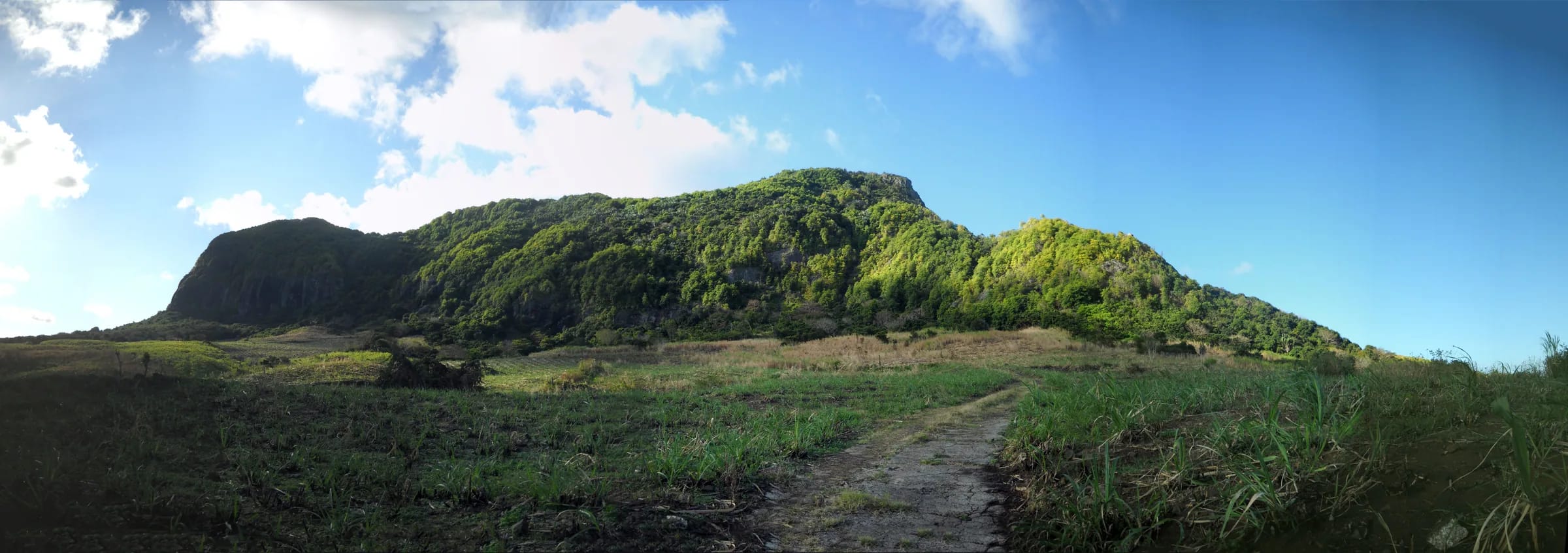
Lion Mountain is low, but it is high enough and far enough into the trade wind to catch cloud. Hikers report fog and rain on the summit while the coast is clear, most recently in the winter of 2026, and a ridge in cloud is both disorienting on an unmarked route and wet underfoot. The soil is a thin, clay-rich layer over weathered basalt that drains slowly and stays slippery for a long time after a shower, which is the single most repeated warning in recorded reviews. In the dry months fallen leaves on the steep forest climb do a similar job, and mud is mentioned in reviews from every season.
The practical consequences are simple. Check the forecast for the south-east specifically, because a forecast for the island or for the west coast tells you little about this ridge. If it rained hard yesterday, expect the forest climb to be greasy and the slabs on the head to be worse than greasy, and plan to stop at the ridge junction. If you arrive to find the summit in cloud, the Eastern Viewpoint on the eastern ridge is lower and often clearer, and the view from there is rated higher than the summit anyway. The wind on the open ridge is a help in heat and a nuisance in winter, when a light shell is worth carrying.
What the summit is doing now
The panel below shows current conditions on the ridge, drawn from live weather data for the summit position. Use it the evening before and again in the morning, alongside the Mauritius Meteorological Services forecast for the south-east and any cyclone bulletin in season. A dry, clear reading at dawn with light wind is the day to go for the head. Cloud on the summit, recent rain or a strengthening south-easterly are reasons to aim for the ridge junction or the Eastern Viewpoint instead, or to spend the morning in Mahébourg and climb tomorrow.
Today on Lion Mountain
Reading the forecast for the summit…
Questions people ask
What is the best month to climb Lion Mountain?
Any month from May to November, with September and October the driest and June to August the coolest. Local guides advise dry weather only and put the season at May to November. December to March is hot, wet and inside the cyclone season, though a clear early morning is still possible if you watch the forecast for the south-east.
Does it rain a lot on Lion Mountain?
More than on the west coast and less than on the plateau. Plaisance, the nearest station, records about 1,659 mm a year, from 258 mm in February down to 49 mm in October. The ridge itself catches more cloud and drizzle than the coast because it stands in the path of the south-east trade winds.
Can I hike Lion Mountain during cyclone season?
Yes on a clear, settled morning with no warning in force, and no under any cyclone warning class. The official season runs from 15 November to 15 May, with most activity from January to March. After a storm has passed, wait a few days for the cane roads, the forest path and the clay on the ridge to drain.
How cold is it on the summit of Lion Mountain?
A few degrees cooler than the coast and much windier. Plaisance records daytime highs of 25 °C in July and August and nights of 19 °C, so a winter dawn on the ridge in a strong trade wind feels cool enough to want a light layer. In summer the problem is heat, with coastal highs of 30 °C and no shade on the upper half.
Is Lion Mountain windy?
The ridge is open to the south-east trade winds and the wind is strongest in July and August. It is rarely a danger on the spine, where the path keeps away from the edge, but it adds to the exposure on the head and makes the Eastern Viewpoint with the flag a cold place to linger in winter.
What if it rained the day before my hike?
Expect the forest climb to be slippery and the slabs on the lion’s head to be worse. The clay soil drains slowly and stays greasy long after a shower. Many hikers go anyway and turn around at the ridge junction, which still gives the view over the bay. If the rain was heavy, choose another day.
Then read the safety page
Wet rock, exposure, heat, timing and the emergency numbers that work in Mauritius.